
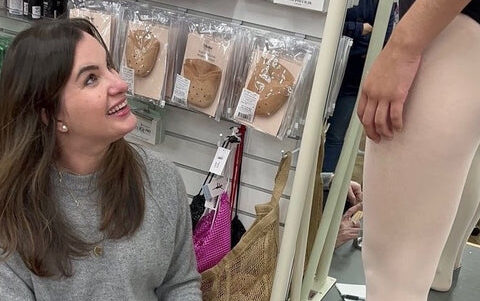
Fit Tip Friday is DRN‘s monthly column where pointe shoe fitters share their go-to advice. For this installment, Kristin Ruggieri, owner of Attitude Dance & Activewear in Norwalk, CT, explains why taking a whole-body approach leads to better fittings. —Emily May, editor, Dance Retailer News
What’s often missed in fittings is taking in the whole picture of a dancer rather than just looking at their feet and ankles. A dancer’s ability to hold and maintain their turnout in a pointe shoe in particular is overlooked a lot.
At my store, we really take a holistic view with our fittings, looking at the whole body, with a special focus on the lower back, the pelvis, and hip rotation. We get dancers to stand in first position and observe them from the side. That way, we can see if the knees are rolling in, or if the dancer is forcing turnout from the ankle. We get them to rise onto half-points in first position to observe their turnout there, too. That’s perfect as a baseline, and we can make sure that aligns with what’s happening on point.
If a dancer is forcing their turnout, it’s important to pay attention to the size of the platform of the pointe shoe you put them in. Sometimes the vamp is too high, and that’s what causes problems, but it’s typically the size and the shape of the box that’s the culprit. I always take photos for dancers so that they can see for themselves if their knees are rolling in or not. The word I use a lot with them is “stability.” “Do these feel stable to you? Are you able to hold your turnout a little easier or do you feel like you’re forcing it?” Usually “stable” is a good descriptor that works for younger dancers.
Former dancer Kristin Ruggieri founded Attitude Dance & Activewear in Norwalk, CT, in 2004. Find out more about her journey from stage to store in this article.