
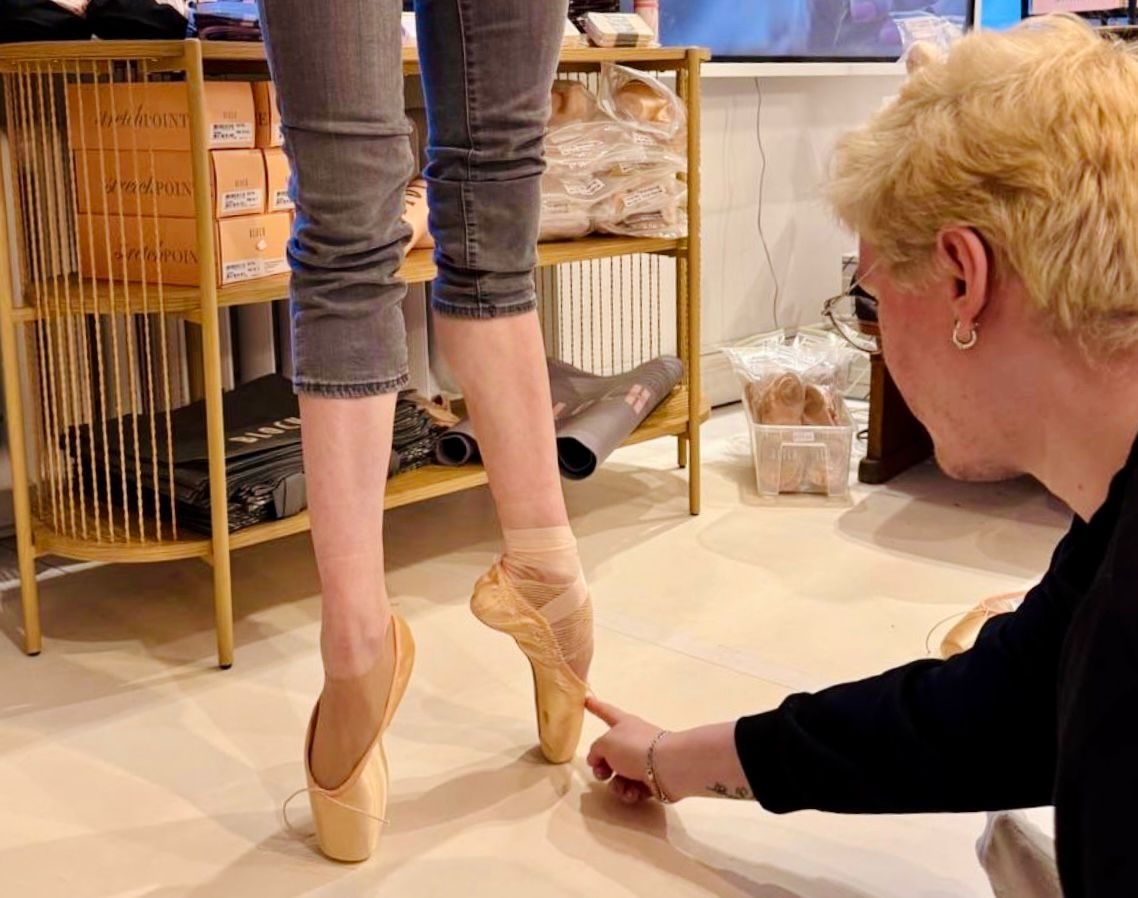
Fit Tip Friday is DRN’s monthly column where pointe shoe fitters share their go-to advice. For this installment, Rob Ferguson—Bloch’s EU/UK market manager, who fits dancers, and trains fitters across the UK and Europe—explains his approach to ensuring dancers feel heard and confident in their pointe shoe fittings. —Emily May, editor, Dance Retailer News
Pointe shoe fitting is both an art and a science. There are points of agreement between fitters, and points of contention, which I think is part of what makes it interesting. My overarching philosophy is that if a shoe is right for a dancer, it’s right for them. They shouldn’t feel pressured to follow someone else’s opinion about wearing different sizes or padding. (Though taking advice from a wide variety of professionals and peers is also a good idea.) If a shoe is safe, supportive, comfortable, elegant, and the dancer can move well in it, then it works.
Sometimes professionals will come in and ask, “What do you think I should change?” And I’ll ask them back: “Do you feel like anything needs to change? Do you like how it looks and feels? If so, why change it?”
A big part of fitting is helping dancers realise they have a voice. They don’t need to be deferential in the process. That comes from building rapport—making little jokes like “Are you excited? Are you nervous? Don’t be, I’m very nice!”—and asking open-ended questions. “How do the toes feel at the end of the shoe?” is much better than “Are your toes curled?” because it opens up a conversation. If someone looks unsure, you can ask them to plié, and curl and release their toes to help them feel the difference.
Some of the most challenging fittings are with very young dancers who are very timid or defer to their parents, or when there’s a language barrier. Working in a London store, which is so multicultural and tourist-heavy, we meet many dancers who don’t have a strong shared language with us. In those cases, you rely heavily on gesture—miming the toes, pointing to pressure points on the shoe, using nods and head shakes—to communicate what the foot is doing inside the shoe.
Rob Ferguson is the EU/UK market manager for Bloch. He provides professional pointe shoe fittings for dancers, leads seminars on fitting, and trains wholesale clients and new employees in Bloch’s sister stores across Europe. You can find out more about him in this DRN article.