
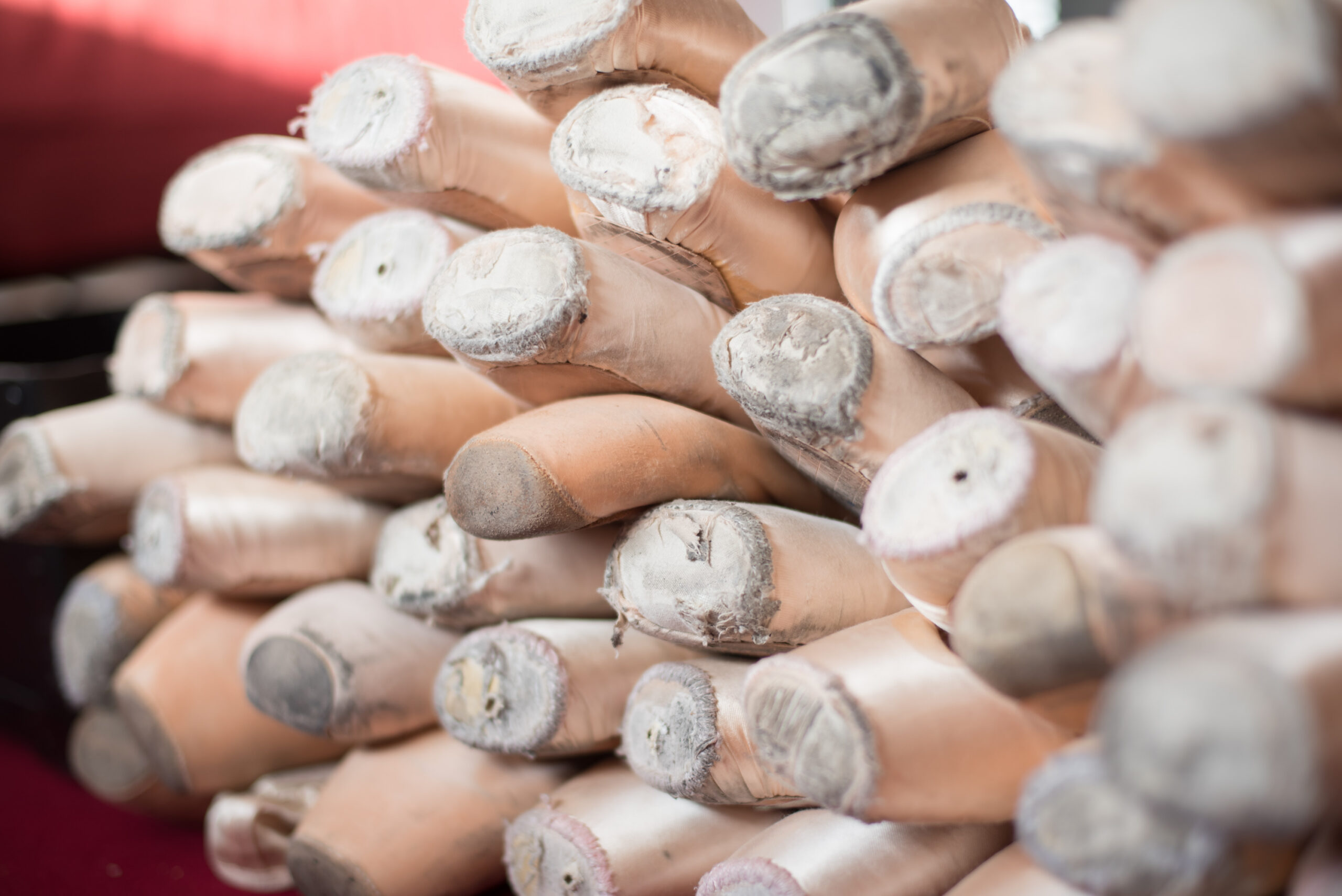
Pointe shoes have a notoriously short lifespan, meaning that thousands end up in the trash each year. So, with so many eco-friendly dancewear brands, like tights and leotards that have been designed to leave a smaller carbon footprint, why do pointe shoes seem to get a pass when it comes to sustainability?
Part of the problem is that there’s less of a desire all around to design, buy, or sell new, innovative pointe shoes in general—never mind more sustainable ones. Ozgem Ornektekin, a mechanical engineer specializing in sustainability and the founder of Petit Pas New York, which upcycles old pointe shoes provided by the School of American Ballet into leather and satin accessories, says it isn’t surprising that dancers would prioritize their favorite shoe. “They’re thinking about their health and their performance, and then sustainability and other things will fall into second, third, fourth, maybe fifth place,” Ornektekin says of dancers and their preferred pointe shoes—which, more so than tights or leotards, can make or break a performance. “Everybody has their favorite, because you’re finding a glove for your feet, basically.”
And then there’s ballet culture itself, where quickly going through many pairs of shoes is perceived almost as a badge of honor or something worth bragging about. Ashley Coupal, a first artist with English National Ballet and a member of the company’s Green Team, which spearheads environmental initiatives, says that’s an area where dancers can work to improve.
“We need to switch the narrative and be like, ‘I only went through one pair this month,’ ” Coupal tells Dance Retailer News.
Artists have found creative ways to keep pointe shoes out of the trash by using them in crafts and as souvenirs, but these endeavors usually entail leaving the pointe shoe in its original form (upcycling) instead of breaking it down into raw materials (recycling). And while upcycling certainly has value at the artisanal level, finding ways to mass-recycle pointe shoes could offer a solution to more systematically tackling the large-scale problem of thousands of pointe shoes ending up in landfills.
So how can members of the dance ecosystem—including manufacturers, buyers, and sellers of pointe shoes—help beef up sustainability efforts? With a little outside help, it is possible to recycle most pointe shoes, yet actually doing so has proven to be a tricky endeavor.
Hurdles to Pointe Shoe Recycling
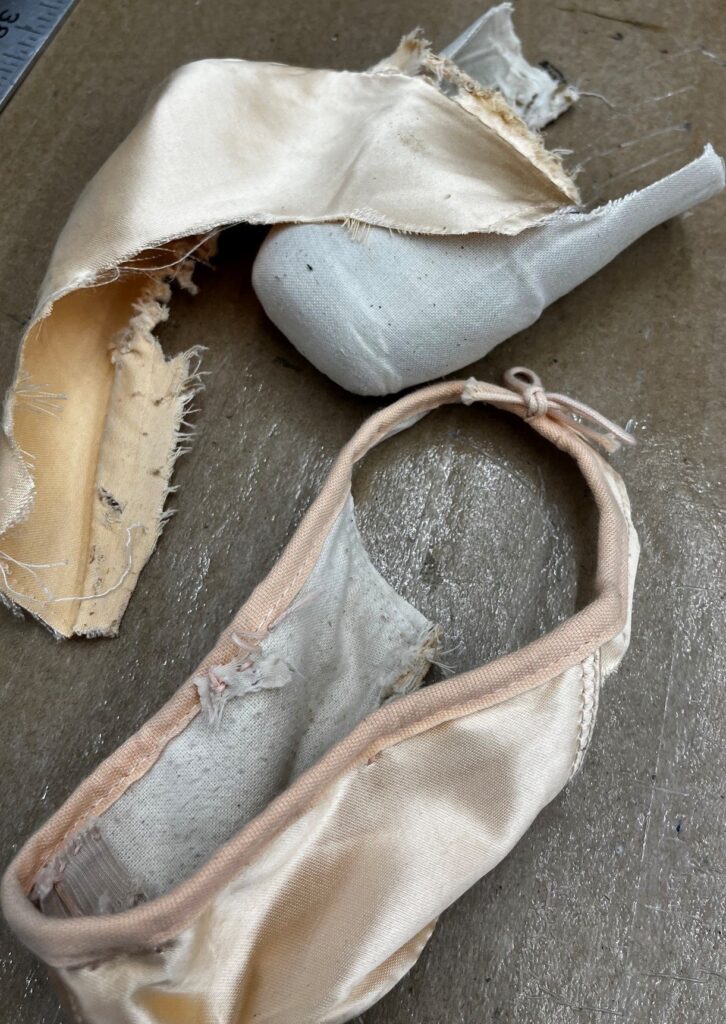
According to Ornektekin, the individual parts of traditionally made pointe shoes are mostly organic and recyclable, reusable, or compostable: The box of the shoe and the insert can be recycled with paper or composted; the satin pieces can go to textile recycling; the leather pieces can be upcycled by businesses that work with leather; and for some companies, like Freed, even the nontoxic glue is compostable.
The problem is that all of these elements need to be separated from each other before they can be recycled, and pointe shoes are so well constructed that it’s difficult to take them apart without the right tools and expertise. Ornektekin says she spent about an hour trying to disassemble just one pointe shoe during her first attempt.
Pointe shoes made from nontraditionall, synthetic materials pose a different set of problems. They tend to hold up longer, so dancers go through them less quickly—meaning fewer pointe shoes in trash bins. However, unlike organic materials, which decompose relatively quickly, synthetic materials are not biodegradable, meaning they stick around for much longer in landfills.
Many thermoplastic elastomers (a material that’s used in non-traditionally constructed shoes, like Gaynor Mindens) are technically recyclable, but they need to be separated from other materials first—and Ornektekin says that in her experience, Gaynor Mindens are nearly impossible to take apart.
“They are so well put together that you really can’t pull them apart and recycle them,” says Eliza Minden, who founded Gaynor Minden partially due to her outrage that traditionally made pointe shoes often only last one performance. “But because they last three to five times longer, dancers use fewer of them, and many fewer end up in landfill.”
Giving Old Shoes a New Life
Some pointe shoe brands are partnering with third-party companies to tackle the tedious task of breaking down pointe shoes for recycling. English National Ballet, for example, teamed up with First Mile, a UK-based waste management and recycling company, to start the ballet company’s Drop-Off Pointe initiative, which includes a large bin where dancers can deposit their used pointe shoes. The shoes (mostly Freeds) are then taken apart, broken down, and repurposed for things like stuffing in furniture and punching bags. Last season alone, English National Ballet recycled about 600 pointe shoes.
“It’s just a great way to kind of give a second life to the pointe shoe, because it’s so sad that they don’t last that long,” Coupal says.
Freed has been looking into using a private recycling company, TerraCycle, to create a pointe-shoe recycling program at its New York City store. Julie Smith, retail sales manager for Freed of London USA, tells Dance Retailer News that if the plan were to go ahead, dancers would be able to deposit old pointe shoes in the store’s zero-waste box. When the box is full, it would be sent back to TerraCycle in New Jersey for shoe deconstruction and recycling.
Who Pays for Sustainability?
These kinds of systems aren’t necessarily doable everywhere without a private recycling company’s help; and dancers, stores, schools, and ballet companies may be limited by where they live and what nearby recycling services are available to them.
Another hurdle? Cost. Many arts institutions are already strapped for cash, and may be wary of the extra expense incurred in hiring a third party to handle recycling. While Coupal acknowledges that circumstances vary at different companies and schools, she encourages everyone to do some research, get creative, and see what’s possible in their own community.
“It’s not the same everywhere, but I think the more you show your concern towards the environment, the more people are interested in investing in you,” Coupal says.
What the Dance Industry Can Do
Individuals can do their part to ensure fewer pointe shoes end up in the trash by researching recycling options for their own store, school, or company; by encouraging dancers to reuse add-ons like ribbons and elastics; and by extending the lives of traditionally made shoes with things like shellac and Jet glue. Gaynor Minden shoes, which are already designed for longevity, can last even longer if they’re aired out between wears.
But perhaps the biggest impact can be made by putting pressure on the pointe shoe manufacturers themselves to work on sustainability solutions. Ornektekin suggests shoe manufacturers or stores could consider implementing buy-back programs, where dancers get a few dollars off their next purchase if they bring in an old pair of pointe shoes for recycling or upcycling. She points out that because they design and assemble these products, manufacturers are best situated to figure out how to make them more sustainable—and what to do with all those dead ones.
“A general message for all manufacturers: If you’re manufacturing something, you’ve got to figure out what happens to the end of life of that [product],” Ornektekin says. “Everything should have a home afterwards.”
Rebecca Corey is a writer based in New York City. Her work has appeared in Pointe and Dance Teacher, as well as on Yahoo News, Yahoo Life, and CNN.