
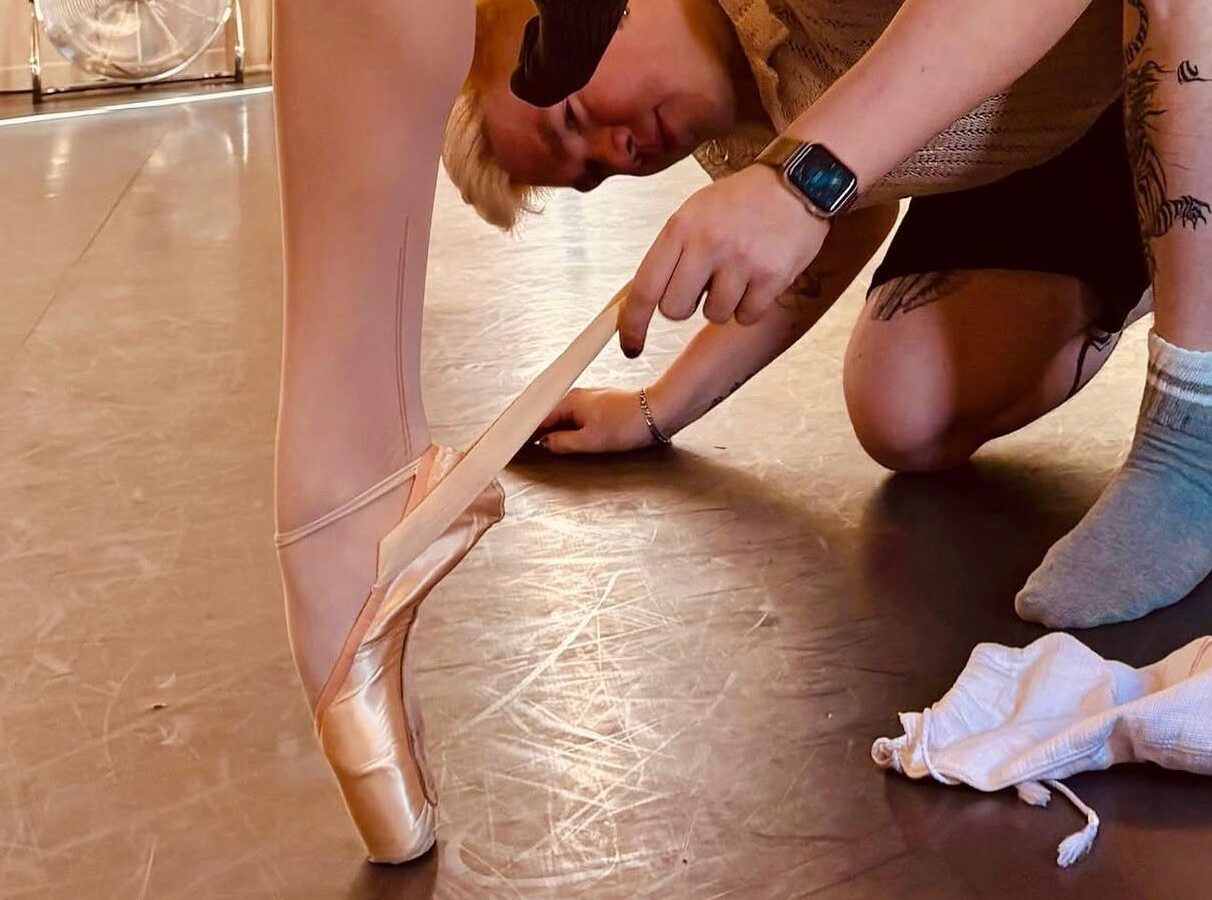
Fit Tip Friday is DRN’s monthly column where pointe shoe fitters share their go-to advice. For this installment, Rob Ferguson—Bloch’s EU/UK market manager, who oversees the brand’s London flagship store, fits dancers, and trains fitters across the UK and Europe—returns to share his “theory of relativity” for pointe shoe fitting. —Emily May, editor, Dance Retailer News
When I’m training new fitters—whether in the Bloch store or with wholesale clients—I always encourage them to imagine shoe features on a sliding scale. Picture a graph, with the X-axis being width and shape and the Y-axis being length. Changing one factor often requires the other to shift in the opposite direction.
For example, if a dancer is in a shoe that is too small (5XXX), you might try the half-size up (5.5XXX). But that can sometimes make the shoe too large overall, so you then compensate by adjusting the width down (5.5XX), restoring balance so the shoe doesn’t feel baggy.
It’s all about relativity. You can also plot vamp length, shoe strength, and shank hardness on that same imaginary graph—an abacus of features that you slide up and down to find the right fit. I sometimes describe it like a DJ on a mixer: “Why is that suddenly too big? Bring it down. Now she’s sinking—maybe we need a harder shank.” It’s a constant adjustment based on how the dancer feels and performs in the shoe.
Rob Ferguson is the EU/UK market manager for Bloch. He oversees the running of the brand’s flagship store in London and provides professional pointe shoe fittings for dancers. Ferguson leads seminars on fitting, and trains wholesale clients and new employees in Bloch’s sister stores across Europe. You can find out more about him in this DRN article.