
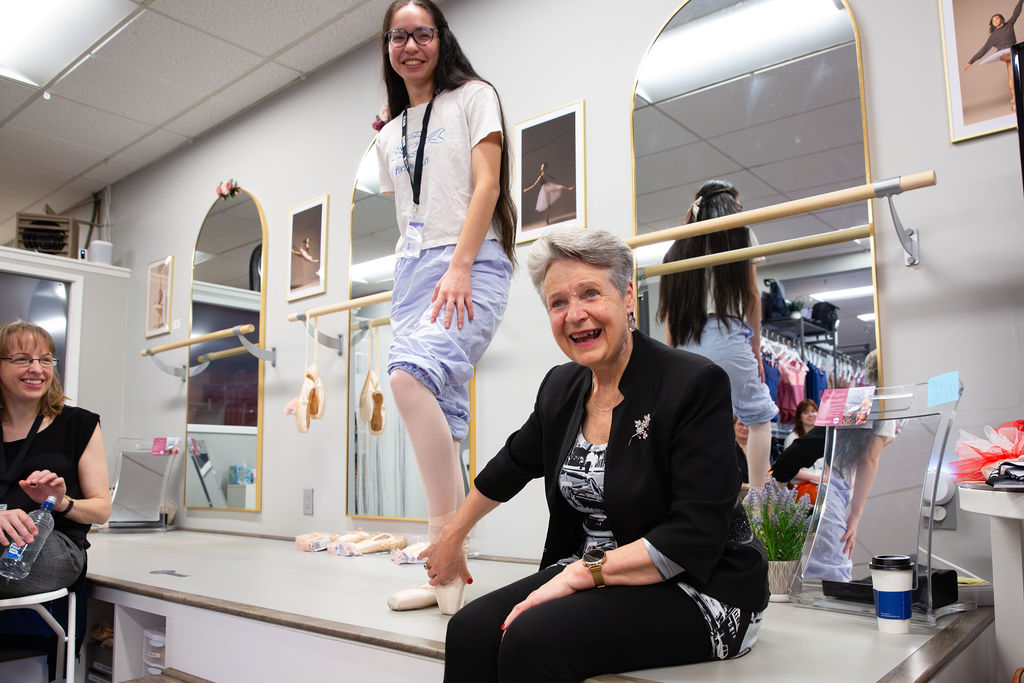
At 15 years old, Esther Juon had a somewhat late start to ballet. But she progressed rapidly, dancing as a full-time student with the Zurich Opera House in ballets, operas, and operettas before leaving Switzerland to train at major studios in London. In class one day, she was asked to do something she wasn’t capable of. She fell and broke her back. Juon’s recovery took seven years and a spinal-fusion surgery. Once she recovered, she had an entirely new outlook on dance.
“Because of what happened to me, I wanted to make sure that when I [went] back to the ballet world, I [approached it] from an anatomical point of view,” says Juon.
Switching focus to teaching, Juon always sent her students to the osteopath before they started working together, so she could accommodate any issues in the class. “That built a relationship of working with the dancer as an individual,” says Juon. “That’s always been my goal.”
Eventually, her attention turned to pointe shoe fitting. In the mid-1980s, she attended every course and information session she could that were run by brands like Freed of London, Gamba, Gandolfini, and Porsellie. It was during one of these sessions that Juon met physiotherapist Shirley Hancock, who worked with the English National Ballet and the Royal Ballet. Hancock introduced her to the metatarsal lift—an exercise designed to activate the intrinsic muscles beneath the arch of the foot and support dancers in working safely on pointe. The exercise would later become a cornerstone of the eponymous training method Juon went on to develop for dancers and fitters alike.
Reframing Pointe Shoe Fitting Through Alignment
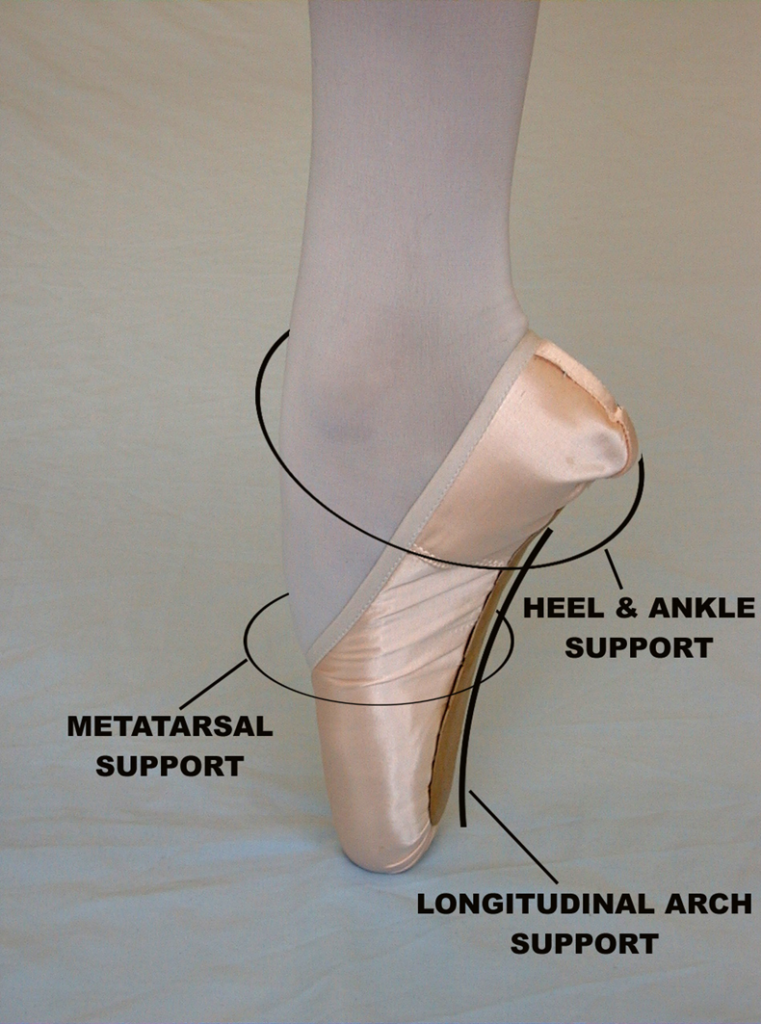
By working with physiopodiatrists and osteopaths, Juon developed her own method for fitting pointe shoes. She explains that the foot naturally has three points of support when standing on the ground: the heel, the head of the first metatarsal (under the big toe), and the head of the fifth metatarsal (under the fifth toe). On full pointe, the body weight is transferred almost entirely onto the tips of the toes, meaning the pointe shoe must replace and re-create the natural support system of the foot.
As a result, Juon’s method emphasizes awareness of a third point of support when on pointe: the transverse arch across the metatarsal heads, which helps distribute weight away from the ends of the toes. By cultivating this awareness, selecting a shank that properly supports the dancer’s arches, and ensuring that the heel of the shoe together with the ribbons creates an additional stabilizing point of support, the fitter helps the dancer achieve a more secure and balanced foundation on pointe. Juon also tapes the toes individually to support their growth plates and allow them to move independently of each other.
For Juon, pointe shoe fitting is ultimately all about making sure the dancer’s body is in alignment. When it’s not, injuries occur. As part of her pointe shoe fittings she will examine the dancer’s body—such as how they point their feet; if their knees or hips are turned out—and then fit the shoes accordingly.
Training a New Generation of Fitters
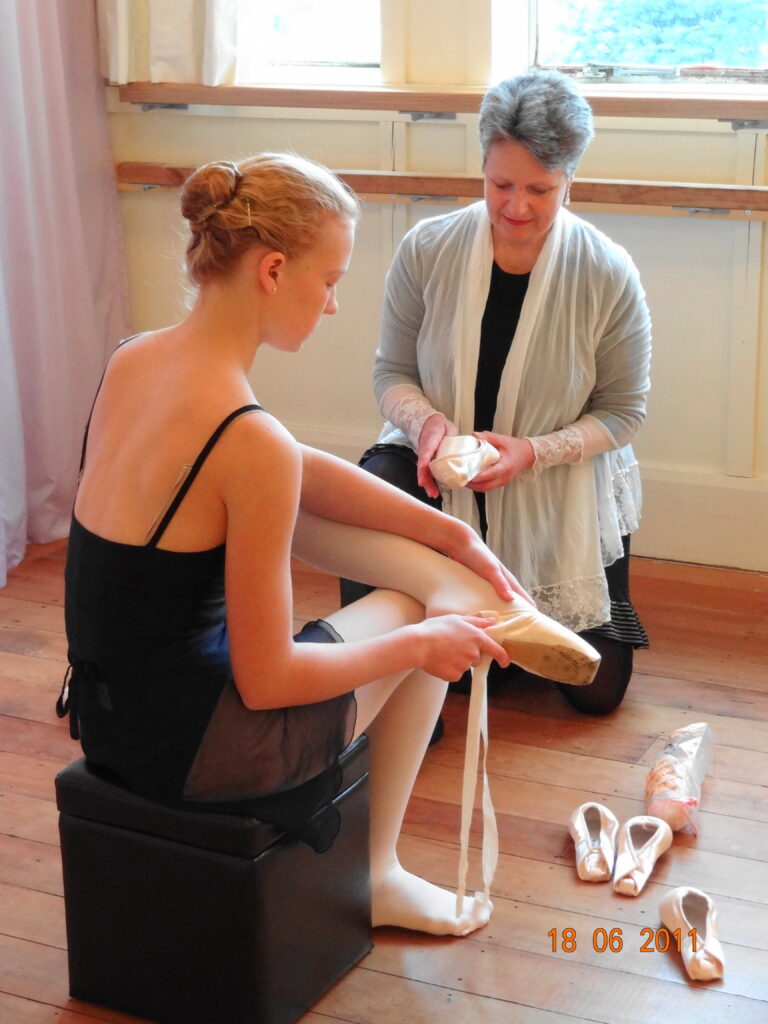
Now based in New Zealand, Juon disseminates her approach through Juon Pointe, an organization that promotes dancer safety and pointe readiness. She conducts a three-part mentoring course via Zoom for dance teachers, dancers, pointe shoe fitters, and dance health professionals, with each section taking approximately six to eight weeks to complete. Juon Pointe also offers a full pointe-shoe-fitting course that is more extensive. Including coursework, written reports, and practical assignments, it takes around a year to complete.
The first part of Juon Pointe’s mentoring course focuses on foundation (non-weight-bearing)—building foot strength, ankle mobility, and correct alignment. The second part is about applying strength (weight bearing), transferring skills to standing work, demi-pointe, and proper positions. The third part is the final preparation for pointe and explores core strength, balance, turnout, and pointe-readiness tests. All students of the program, dancers and fitters alike, take part in the physical exercises themselves so they know how the proper form is supposed to feel.
Juon says too many dancers are rushed onto pointe before their bodies are ready for it. The idea of her courses is that by understanding their anatomy and alignment, dancers will be better prepared.
“Once they’ve done this course, they cannot go back to what they did traditionally, because they have such a different viewpoint,” Juon says.
From Zoom Room to Global Summit
Over the years, Juon has shared her method with the world, working with teachers, pointe shoe fitters, dance health professionals, and dancers in countries including the U.S., Canada, the U.K., Germany, Denmark, Australia, Colombia, Spain, and India.
Last year, she decided to take things one step further and held the first Pointe Shoe Summit, in Bellevue, WA. There, teachers, professional dancers, pointe shoe fitters, and dance health professionals from around the world convened to learn about the Juon Pointe method. This year’s event will take place in Singapore: August 5–7, for professional dancers, fitters, and teachers;August 8, for parents and dancers under age 18; and August 9, for pre-booked foot and pointe-shoe assessments.
Rhea Lwin, owner of On Pointe Dancewear in Bellevue, helped create and design last year’s Pointe Shoe Summit and will present again in Singapore. Her session will offer a technical deep dive into the pointe shoe market, including modern pointe shoe technology and available brands. The idea is to help teachers and dance health professionals better understand the options available for their students and clients.
Lwin first met Juon when she was part of a Zoom fitting that Juon was having with a professional dancer from her local area. After that, Lwin underwent the yearlong mentoring program to be trained in the Juon Pointe method.
“Esther really sharpened my eyes to the details in a fitting,” Lwin says. “I learned how to look at alignment in a whole different way and to notice all these different details in a dancer’s body.”
Backed by Science
Another presenter returning to the summit (in a digital capacity) will be dance health consultant and podiatrist Georgina Barr. She met Juon at the International Association of Dance Medicine and Science regional conference in Melbourne, Australia, in 2017 and has worked with her ever since. Barr created a validation document for Juon’s pre-pointe assessment that proved it aligned with international medical standards, and continues to update Juon on the latest in the field.
“The Pointe Shoe Summit provides a warm, dynamic and encouraging space to learn,” she writes DRN via e-mail. “It will be a true intellectual and physical exploration of dance dynamics for all attendees.”
Barr added that Juon’s dedication to ensuring safety for dancers comes from a deep love for both the artist and the art form of ballet.
“Her dedication to ensuring accuracy for pointe shoe fitters is at a medical level of attention to detail,” she comments. “This makes her system and processes tried, tested, researched, and trust-worthy.”
Erica Iacono is a writer living in New York City who often writes about marketing and small businesses.